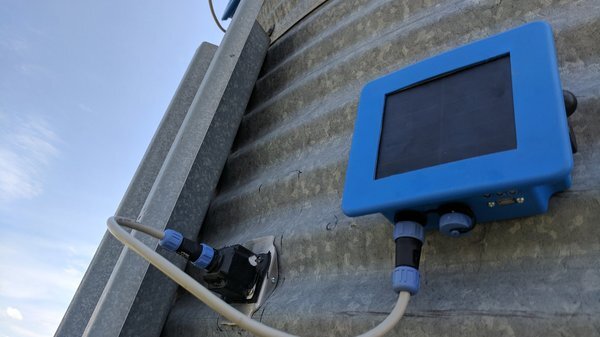
A grain silo, listening for itself to fall.
Piezo-vibration sensors that model the fullness of feed silos in real time — quietly turning depletion curves into two products at once.
- Client
- Little Bird Systems
- Year
- 2020 – 2021
- Role
- Tech lead, via Lofty Labs
- Outcome
- Deployed at Tyson; acquired by Munters
The premise
A poultry barn lives or dies by its feed silos. When the silos run empty unexpectedly, growth halts, welfare suffers, and a delivery truck has to be rerouted — expensively. When they don't deplete on schedule, something else is wrong: birds aren't eating, which usually means birds aren't well.
Little Bird Systems set out to put a small, rugged sensor on every silo and read its fullness from the outside, continuously, without anyone climbing a ladder. The fullness curve over time is the product. Two different audiences need it — for two completely different reasons.
An early-warning system for the flock.
Birds eat on a curve, and that curve is shaped by their growth and their health. When a flock is thriving, the silos draw down predictably. When something is off — ventilation, water, the start of an enteric problem — consumption breaks pattern days before any of the usual signals show up.
The grower app turns that into a single, calm screen: your barns are on track, or house 4 is drinking less than it should be. Built for a grower with a phone in a truck cab at 5am, not a data analyst with a dashboard.
Feed deliveries that route themselves.
A poultry integrator runs a fleet of feed trucks against thousands of silos. The dispatch problem is brutal: predict who'll be empty and when, choose the right routes, don't run a barn dry, don't send a half-empty load.
The same silo curves, aggregated across a complex of farms, become demand forecasts the logistics team can act on. Less wasted mileage, fewer emergency runs, fewer empty silos. Silently, in the background.
What I built
I led the engagement as tech lead through Lofty Labs, partnering with Little Bird's founders on the cloud, data, and product side of the platform — ingestion of telemetry from a fleet of MQTT-connected devices, the model that turns vibration signal into a fullness reading and a depletion rate, and the two surfaces that the readings flow into: a grower-facing app tuned for clarity at a glance, and an integrator-facing system tuned for fleet-scale planning.
Stack-wise, that's Django and PostgreSQL on the application side, AWS IoT for device connectivity and shadows, and a careful product UX layered over both audiences without conflating them.
What changed
Little Bird's sensors deployed onto Tyson farms in commercial production. The company was subsequently acquired by Munters, the global climate-systems manufacturer, where the product continues. From a small set of prototypes on a barn in Arkansas to ag-industry M&A in a couple of years.
Hardware-and-cloud products live or die in the gap between the device and the human who has to act on what it sees. If that's the gap you're staring at, get in touch.
Start a conversation →